
Generation Neck
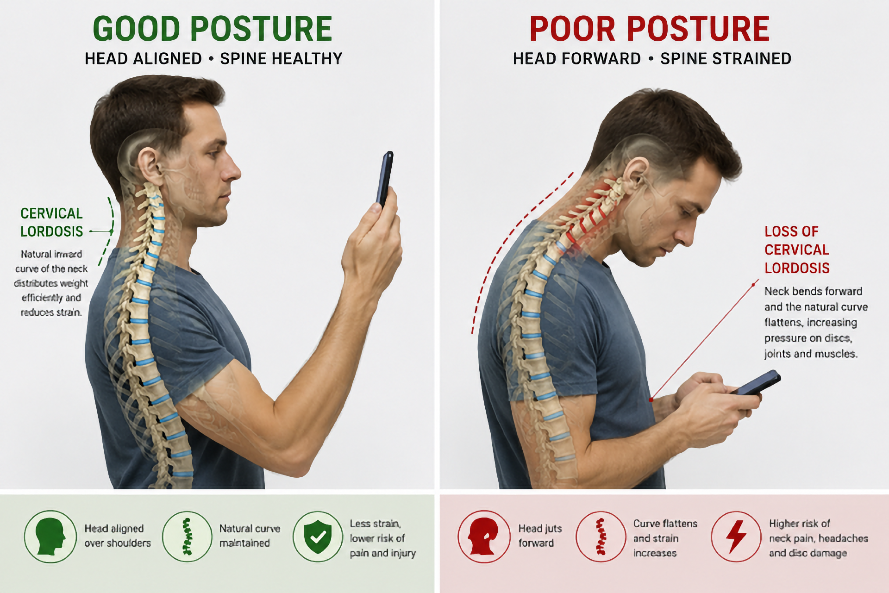
Dr. Kaler's Guide to Saving Your Neck Despite Your Phone
In over 30 years of chiropractic practice, I have watched one trend build quietly in the background — and then explode. When I started, neck problems were common. Today, they are nearly universal. Forward head posture, text neck, disc herniations, upper crossed syndrome, chronic tension headaches — conditions I used to see primarily in adults over 50 are now showing up in teenagers. The culprit isn't a mystery. It's in your pocket.
The average American now spends between two and four hours per day with their head tilted forward looking at a smartphone. For high school students, that number can climb to five thousand hours per year. I call this generation "Generation Neck" — and if you're reading this, there's a good chance you're part of it.
What Your Phone Is Actually Doing to Your Spine
Your head weighs approximately 10 to 12 pounds in a neutral position. That's manageable for the cervical spine — it was designed for exactly that load. But the moment you tilt your head forward to look at a screen, the effective weight on your neck increases dramatically. According to research by Dr. Kenneth Hansraj, Chief of Spine Surgery at New York Spine Surgery and Rehabilitation Medicine, published in Surgical Technology International, a 15-degree forward tilt generates 27 pounds of force on the cervical spine. At 45 degrees — the typical phone-scrolling posture — that force reaches 49 pounds. At 60 degrees, it hits 60 pounds. That is the equivalent of carrying an 8-year-old child on your neck, for hours every day.
Over time, this sustained load does more than create soreness. Research published in the National Center for Biotechnology Information confirms that prolonged forward head posture alters the natural curvature of the cervical spine, strains the muscles, tendons, and ligaments that support it, and places the nervous system under chronic mechanical stress. Disc herniations, cervical degeneration, and conditions like upper crossed syndrome — where the muscles of the neck, chest, and upper back fall into a dysfunctional pattern of tightness and weakness — are the long-term consequence of what most people think of as simply "looking at their phone."
A systematic review and meta-analysis published in PubMed found a significant association between forward head posture and neck pain across multiple populations. This isn't a fringe concern — it is one of the most well-documented musculoskeletal trends of the last decade.
5 Things You Can Do Starting Today
The good news is that this is not irreversible — especially if you act early. Here are five evidence-informed steps you can take right now:
1. Change How You Hold Your Phone
This is the single easiest intervention and most people never think about it. Hold your phone vertically and raise it toward eye level. Even if you don't get it all the way up, holding it vertical fundamentally changes the angle of your neck — stopping the harmful downward flexion pattern that drives text neck. You don't need an app or a gadget. You just need to be aware of where your phone is in space. The moment you raise it, you reduce the mechanical load on your cervical spine.
2. Do Chin Tucks Every Day
The chin tuck — or cervical retraction — is one of the most evidence-backed exercises for correcting forward head posture. A systematic review published in the National Institutes of Health found strong evidence that deep cervical flexor training — which chin tucks directly target — improves neuromuscular coordination and head posture in people with neck pain. To perform a chin tuck: stand or sit upright, and without tilting your chin up or down, slide your head straight back as if trying to make a double chin. Hold for 3–5 seconds, repeat 10 times. Do this several times a day. It costs nothing, requires no equipment, and directly counters the muscular imbalances that phone use creates.
3. Open Your Chest — Address the Full Pattern
Forward head posture doesn't exist in isolation. It almost always comes with rounded shoulders and a tight chest — a pattern clinically known as upper crossed syndrome. Research published in PMC (National Library of Medicine) confirms that treatment programs addressing the full postural imbalance — including chest stretching and scapular strengthening — are effective at reducing pain and improving function. Try a doorway pec stretch: stand in a doorway with your arm at 90 degrees, press your forearm into the frame, and gently lean forward until you feel a stretch across your chest. Hold 20–30 seconds per side. Wall angels are equally effective — stand with your back flat against a wall and slowly slide your arms up and down like a snow angel, keeping contact with the wall throughout.
4. Break the Static Load Every 20 Minutes
One of the most damaging aspects of smartphone use isn't just the angle — it's the sustained, unbroken nature of it. Your neck muscles are held in continuous low-level contraction for extended periods, and that's a primary driver of fatigue, pain, and eventually structural change. Every 20 minutes, set your phone down, lift your chin, and gently move your neck through its natural range of motion — slow side-to-side rotations, gentle tilts, and a few slow nods. Twenty seconds is enough to interrupt the static load pattern and restore some circulation to the muscles and discs. Pair this habit with any screen time — phone, computer, or TV — and you dramatically reduce cumulative strain.
5. Strengthen Your Upper Back — Weakness Is Half the Problem
Text neck and forward head posture are partly a weakness problem, not just a posture problem. The muscles of the upper back — the rhomboids, middle and lower trapezius, and deep neck flexors — are chronically underactive in people who spend long hours looking down at devices. Exercises like band pull-aparts, scapular retractions, and prone Y-T-W raises directly target these muscles and begin to restore balance to the neck and shoulder complex. You don't need a gym — resistance bands and your own bodyweight are enough. Consistency matters more than intensity here: a few minutes daily will outperform an occasional hard workout.
A Word From 30 Years in Practice
I am not anti-technology. Smartphones are remarkable tools and they're not going anywhere. But in three decades of practice, I have never seen a single lifestyle factor cause the volume of cervical spine problems that phone posture is generating right now. What concerns me most is that the damage is gradual and largely silent — people don't feel it building until it becomes a significant problem.
The five habits above are not complicated or expensive. They require awareness and consistency. If you apply them, your cervical spine will thank you decades from now.
And if you're already experiencing neck pain, stiffness, headaches, or any of the symptoms discussed in this article — don't wait. A proper evaluation can identify what's happening structurally before it becomes something harder to address.
‹ Back